

Guides
Contracts and liability policy template: review, dates, custody
A contracts and liability policy template assigning three jobs to named roles: review before signing, date extraction, and custody of the signed version.
Contracts fail small businesses at three moments: when nobody read the document before signing, when nobody extracted the dates out of it, and when nobody could find it afterwards. A contracts and liability policy template is one page that names who does each of those three jobs and what has to happen before a signature.
Adapt the role names to your own company. Nothing below states a legal requirement, sets a threshold any authority imposes, or decides what a clause means: those answers depend on where you are and what you agreed, and a lawyer gives them. The page only guarantees that a human being with the right instructions saw the document in time.
What to take away
- Three jobs, three ownersreview before signature, date extraction after signature, custody forever.
- The review band is defined by consequence, not by contract value. Some cheap agreements carry the worst terms.
- Extraction is a separate step from filing, and skipping it is how automatic renewals happen.
- A policy that describes what the business already does is worth more than one that describes an ideal.
The page
What this covers
Every agreement that binds the business: customer cleaning agreements, chemical and equipment supply terms, subcontractor agreements, building access and key-holding agreements, leases, equipment and finance agreements, platform and software terms accepted by clicking, insurance, and any document that anybody signs on the business's behalf. Clickthrough terms are included deliberately, because they are agreements and they are the ones nobody logs.
Who may sign
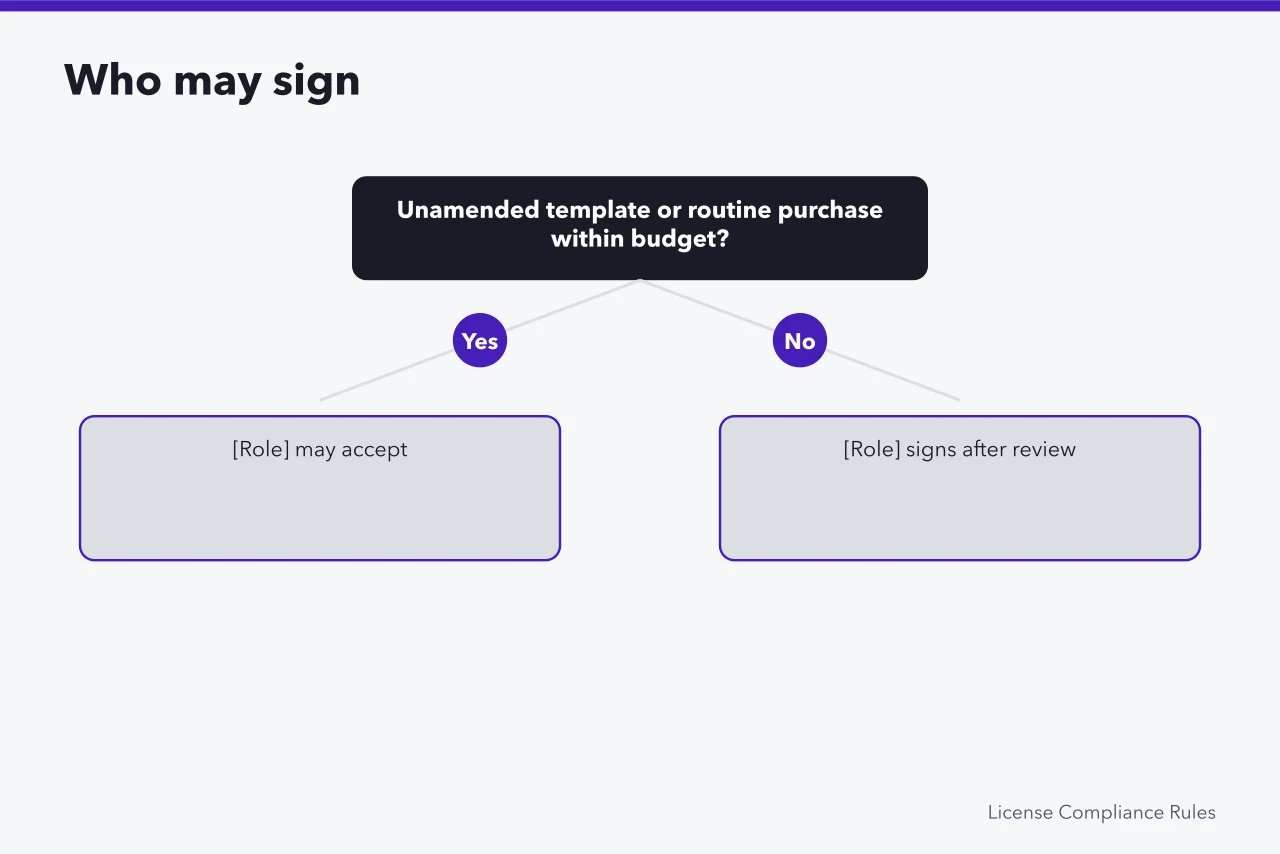
Three tiers. The office manager may accept agreements on our own unamended template and routine purchases within budget. Everything else is signed by the owner and only after the review below. Anything creating an obligation on an owner personally is signed by that owner and only after advice, in writing.
The review band
A document goes to review, however small the amount, if any of these is present:
- An indemnity, a liability cap, or a warranty clause.
- An automatic renewal, or a notice period somebody would have to remember.
- An obligation on an owner personally, or a personal guarantee.
- A requirement to name the other party on our insurance, or to provide them with a certificate of insurance.
- A grant of accesskeys, alarm codes, or entry to a client's building.
- A document on the other side's form rather than our own.
- An exclusivity or non-compete term, or any clause that lets the other side change the price, the scope, or the terms unilaterally.
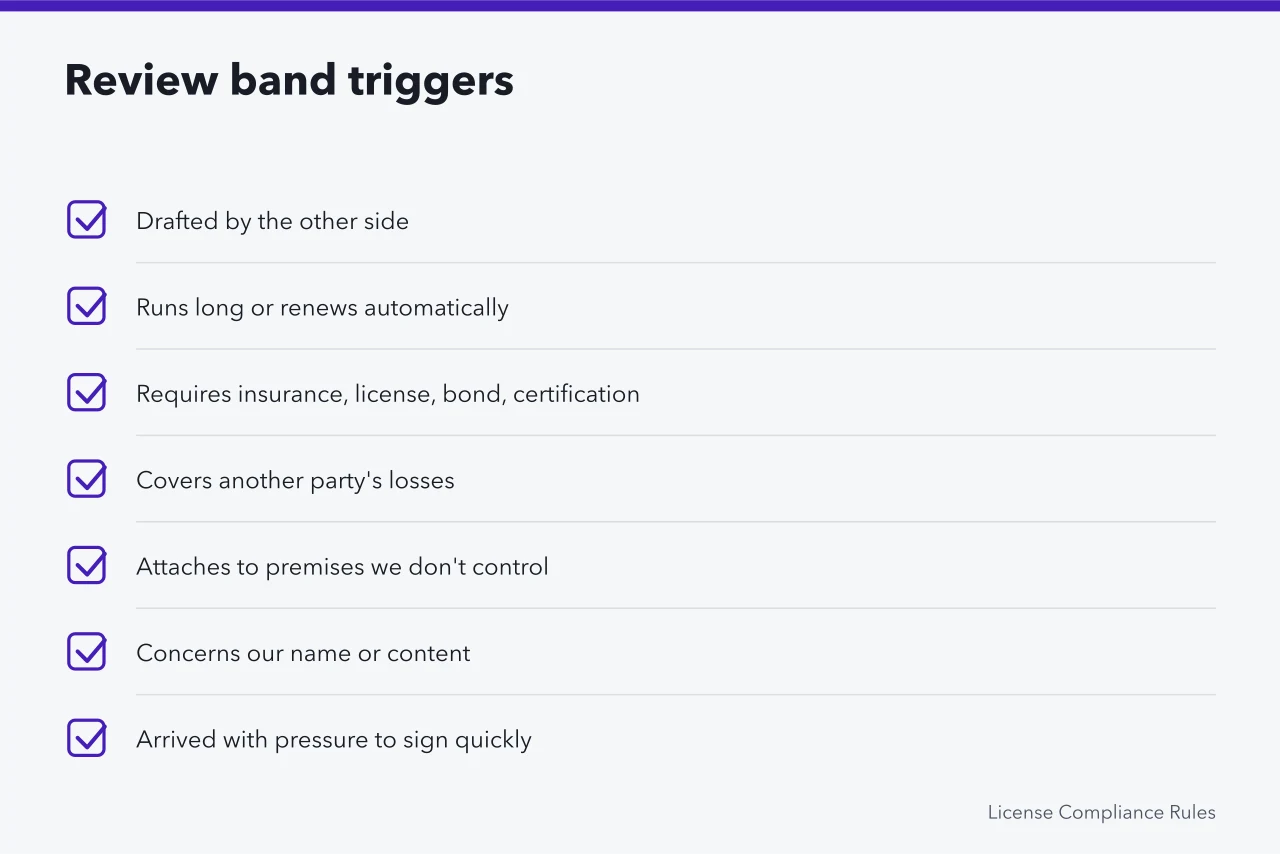
The last one is a real criterion. Which clauses inside these documents actually carry the money is set out in contracts and liability, and the reviewer works from that list rather than reading front to back.
The money clauses
These four clauses decide what a cleaning agreement costs when something goes wrong, and all four are flagged for the owner.
A liability cap sets the most the client can recover from us; on a client's or a general contractor's own form it is often written as the fee for a set period of work, and the reviewer's job is to see how far below the value of the building that sits. An indemnity makes us pay the other side's losses, including a claim a tenant brings after a spill, a missed alarm, or damaged flooring, and it has to be read for whether it covers our negligence only or any loss at all.
A warranty promises the work will be done in a workmanlike manner and to the standard in the schedule, which is why the schedule is stored with the contract instead of left in an email. A termination clause decides whether the client can end the agreement for convenience and what we are still owed for work already done; a termination for convenience that leaves the last month unpaid is exactly what the reviewer is looking for.
What the reviewer records
Not an opinion on the whole document. Four lines:
| Line | What goes in it |
|---|---|
| Party | The exact legal entity on the other side, and the exact legal entity on ours |
| Money after the end | Indemnity, warranty, liability cap, termination consequences: present, absent, or referred |
| Dates | Start, end, renewal, notice deadline, and any date a condition falls due |
| Referred | Anything sent for advice, to whom, and what came back |
If the reviewer cannot complete the Dates line, the document is not ready to sign, because the dates are what the business will actually operate.
Extraction, on the day of signature
On the day a document is signed, the office manager copies every date from the Dates line into the business calendar and into the contract register, a single spreadsheet listing each agreement, the other party, the key dates, and where the signed copy lives. Each date gets an owner and a lead time.
Notice deadlines get a reminder at the start of the notice window rather than on the deadline itself, because the deadline is the day you are already too late. Diarize the window, not the deadline, and the whole of the notice period stays available.
Custody
One place holds the signed version, its attachments, and every later message that changed it: the owner keeps a single folder in the company's shared drive, named Contracts, with each agreement filed under the other party's name. The schedule or statement of work is part of the contract and is stored with it. Emails that varied the agreement are stored with it too, because an informal variation that nobody can produce is an argument you will lose.
When something goes wrong
Before responding to any complaint, claim, or demand, the operations manager reads the agreement and records: what we promised, what limits apply, what notice the document requires us to give, and by when. Notice provisions in contracts have their own deadlines and their own required methods, and both are commonly missed while everyone is drafting a reply.
Review of this page
Read once a year and whenever a role changes hands. The annual questions are whether anything was signed outside the band, whether any renewal happened by default, and whether the custody location still holds everything it should.
Making it true rather than aspirational
Two failures make a policy like this decorative.
The first is a review band nobody can apply. If the reviewer has to judge whether a document is important, they will judge inconsistently under time pressure. The list above is written as facts you can see on the page rather than as importance, and that is what makes it usable by whoever is on duty.
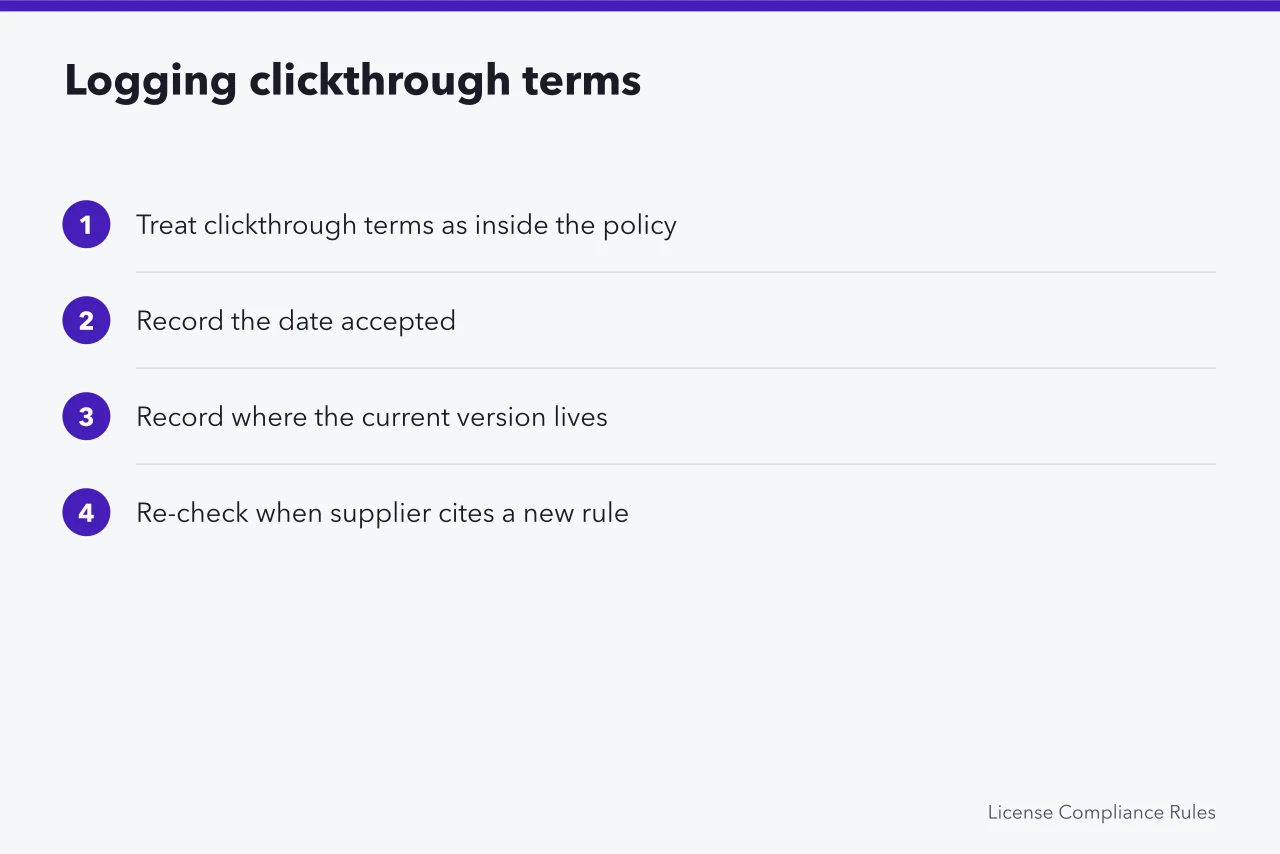
Second: treat clickthrough terms as outside the policy. They are agreements, they change unilaterally on notice, and they are how much of a small business's obligation arrives without any signature. Log them in the contract register, with the date accepted and where the current version lives.
When a supplier frames a change to those terms as something a new rule requires, ask for the rule. The claim is checkable and often wider than the rule it cites.
What this page cannot do
It does not tell you what any clause means, whether a cap is effective, or whether a term is enforceable where you are. Those are legal questions, and the honest answer is that they turn on jurisdiction and facts.
It does not tell you whether you hold the licenses, permits, and insurance your contracts require. Those come from state and local licensing authorities rather than from the contract, and checking them is a separate exercise.
It does not substitute for advice on the documents in the review band either. The U.S. Small Business Administration's guidance on staying legally compliant draws the same line between routine administration and the questions that need a professional, and Cornell Law School's Legal Information Institute outline of contract law is a fair background read for whoever ends up doing the reviews.
Common questions
We are two people. Who reviews?
The one who did not negotiate it. The value is a second reading by someone with no interest in closing the deal, and that exists in a business of two.
What if a document in the review band has to be signed today?
Then the decision to sign without review is made by whoever holds the authority to make it, and it gets recorded as such. A policy is not a ban. It is a way of making sure that skipping the step is a decision somebody took rather than something that happened.
Do we really need to log software terms?
Log the ones the business depends on. If losing access would stop you trading, or if the terms govern data you hold about other people, it belongs in the register with a note of where the current version lives.
How long do we keep signed agreements?
Longer than the contract runs, because exposure can outlast performance, and your state's statute of limitations for written contracts is what sets the outside limit. How long that is depends on the claim and the place, so it is a question for a lawyer with your document in front of them, and the safe operating answer in the meantime is not to delete anything you have not been advised to delete.