
Guides
WorkSafeBC Registration for Residential and Janitorial Cleaning Companies
WorkSafeBC registration for residential cleaning and janitorial firms in BC: who must register, the classification units, what to submit, how premiums work.
What to take away
- WorkSafeBC registration is mandatory for most BC residential cleaning and janitorial employers, even with one part-time worker.
- Residential cleaning and commercial janitorial work sit in different cleaning services classification units, 764018 and 764014, and premiums are calculated on assessable payroll.
- Registration is separate from municipal business licences and private strata rules.
- If you skip registration, WorkSafeBC can retroactively assess claim costs and issue penalties or stop-work orders.
- Your online application needs a payroll estimate, business details, and a description of cleaning operations.
Who has jurisdiction in BC
WorkSafeBC is the provincial workers' compensation authority. It sets coverage rules, classification units, and premium assessments. Municipal governments issue business licences, and strata corporations or private clients set their own entry rules. These three layers do not replace one another.
A residential cleaning company operating in Vancouver, Victoria, or Kelowna still reports payroll to WorkSafeBC if it has workers. A municipal licence does not remove that duty. A private contract that calls a cleaner an independent contractor also does not decide the matter. WorkSafeBC looks at the working relationship, not the label.
If you clean condos or stratas, Canadian provincial strata rules explains how those private rules work.
What triggers registration
WorkSafeBC registration for residential cleaning is triggered when a person or company hires a worker in BC. A worker includes a part-time cleaner, an hourly team member, or a subcontractor under your direction.
It does not matter if the job is called casual or trial. Under the Workers Compensation Act, the legal test is broader than the Canada Revenue Agency's employee test.
| Situation | Registration requirement |
|---|---|
| You employ one or more cleaners | Mandatory coverage is required |
| You use a subcontractor who uses your supplies and follows your schedule | WorkSafeBC may treat that person as a worker |
| You operate alone with no paid help | Optional personal coverage is available |
| You run a partnership with working partners | Partners may need coverage even without employees |
WorkSafeBC assigns cleaning companies to classification units. In its 2026 classification and rate list, residential work is listed as domestic cleaning under classification unit 764018, while commercial cleaning or janitorial services are classification unit 764014. Each unit groups similar employers so premium rates reflect risk. A company that cleans both homes and offices should describe both lines of work on the application and let WorkSafeBC decide the classification; the unit it assigns appears on your account summary. Do not guess at a rate, because residential cleaning premiums in BC depend on your payroll and your claims history. What coverage costs is a premium calculation, not a price list.
For a concrete cost anchor, WorkSafeBC publishes an average base premium rate every year. It is an average across employers, not a residential cleaning quote, and your cleaning services classification unit rate and claims history can raise or lower the final amount.
Employment standards such as vacation and overtime sit in a separate system, with their own rules in each province, and do not change the premium. The WorkSafeBC average base premium rate for 2026 is $1.55 per $100 of assessable payroll. To estimate a base premium, divide your assessable payroll by 100 and multiply by your own classification unit's rate.
What to submit
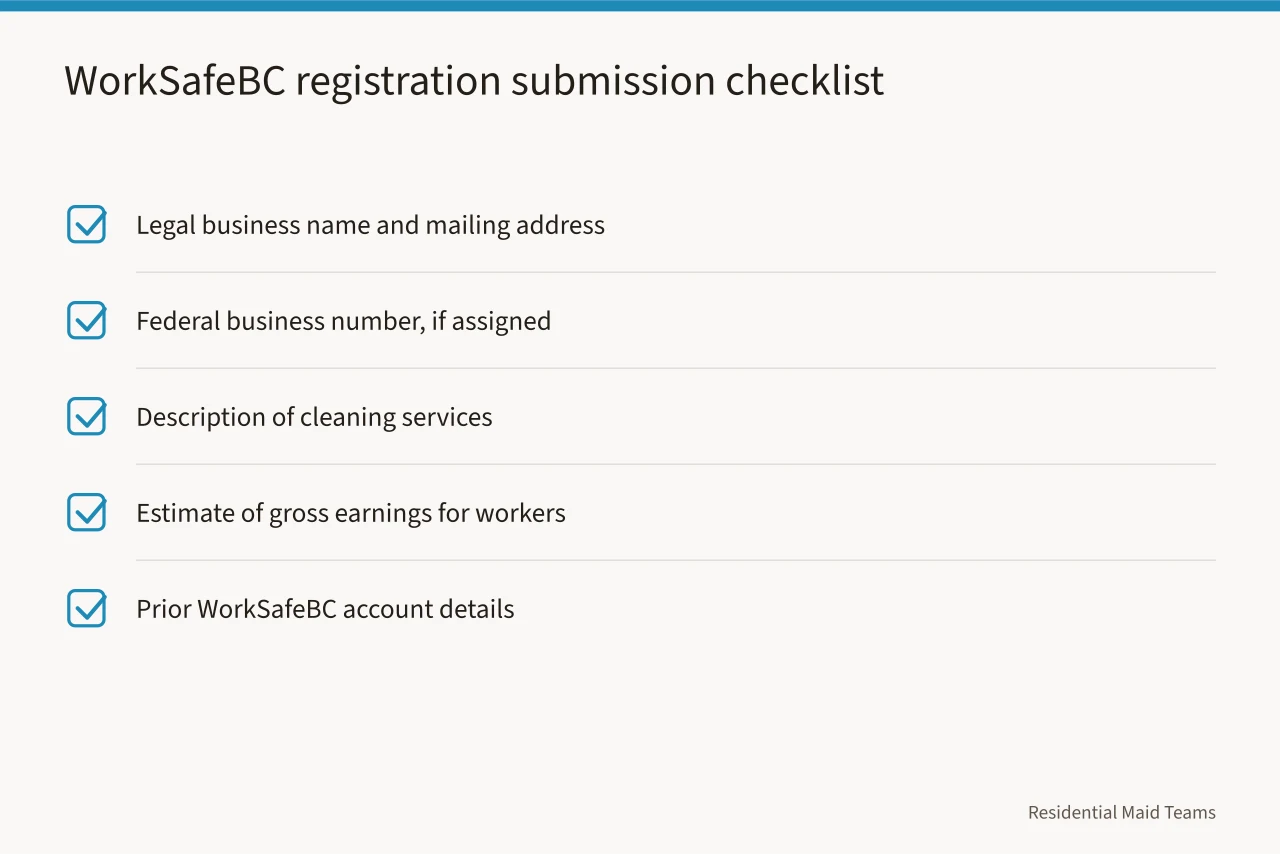
To open an account, WorkSafeBC asks for your legal business name, address, and your federal business number if you have one.
WorkSafeBC also needs a description of your cleaning services and an estimate of the current year's assessable payroll. Name the classification unit you believe applies. Include any dates of prior coverage or a merger.
Federal GST and HST accounts are separate. The CRA sets the charge and collect rates for cleaning services. You cannot use a WorkSafeBC number to file GST.
How long approval takes
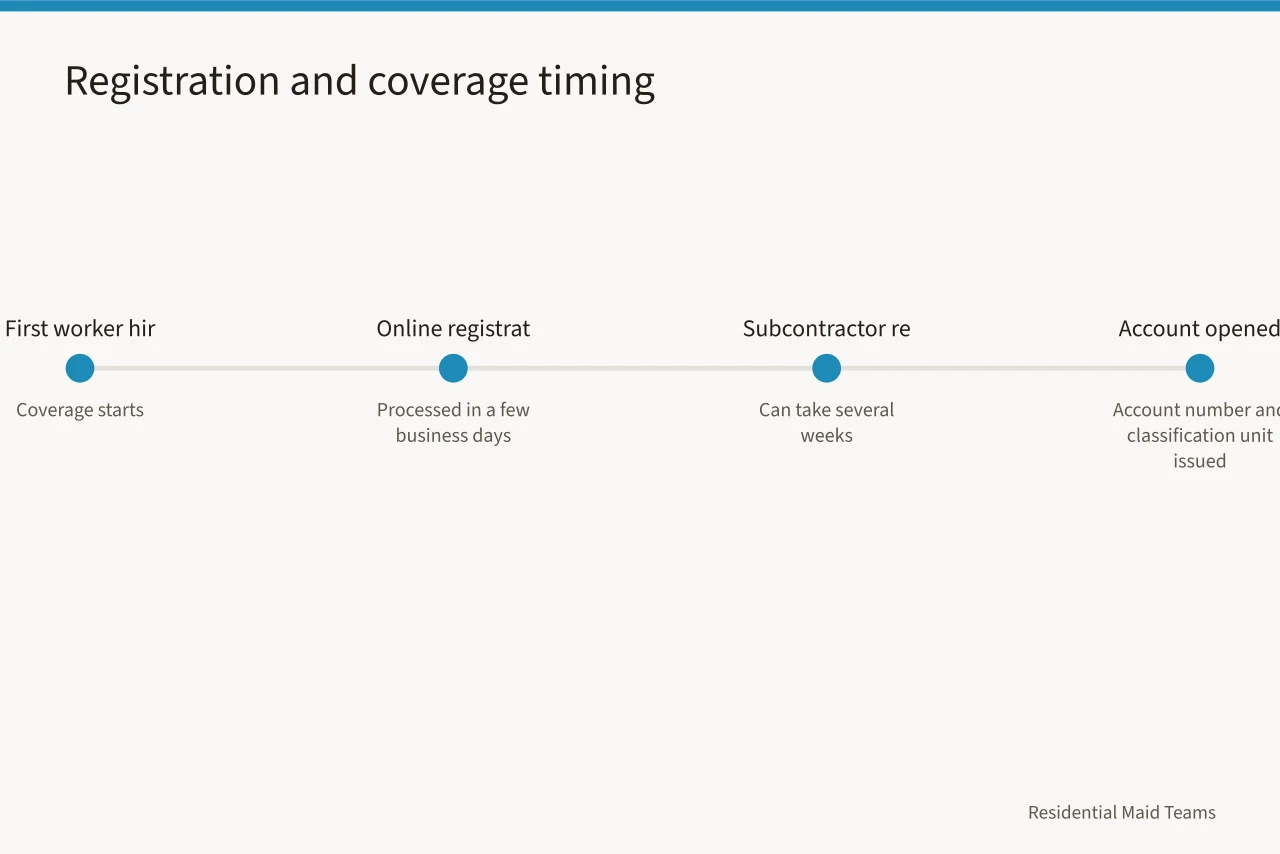
WorkSafeBC processes most online registrations within a few business days, and you receive an account number and a classification unit.
If WorkSafeBC must review whether a subcontractor is a worker, the decision can take longer, sometimes several weeks. Do not wait until the first invoice to register. Coverage starts when your first worker is hired, not when the account opens.
While you wait for that account, use a training checklist for home cleaning staff to prepare new hires.
What happens if you skip it
If you do not register, WorkSafeBC can still accept a claim from an injured cleaner. You may be billed for the full cost of that claim from the date of injury, plus a penalty for failing to register. WorkSafeBC can also issue a stop-work order on your cleaning jobs.
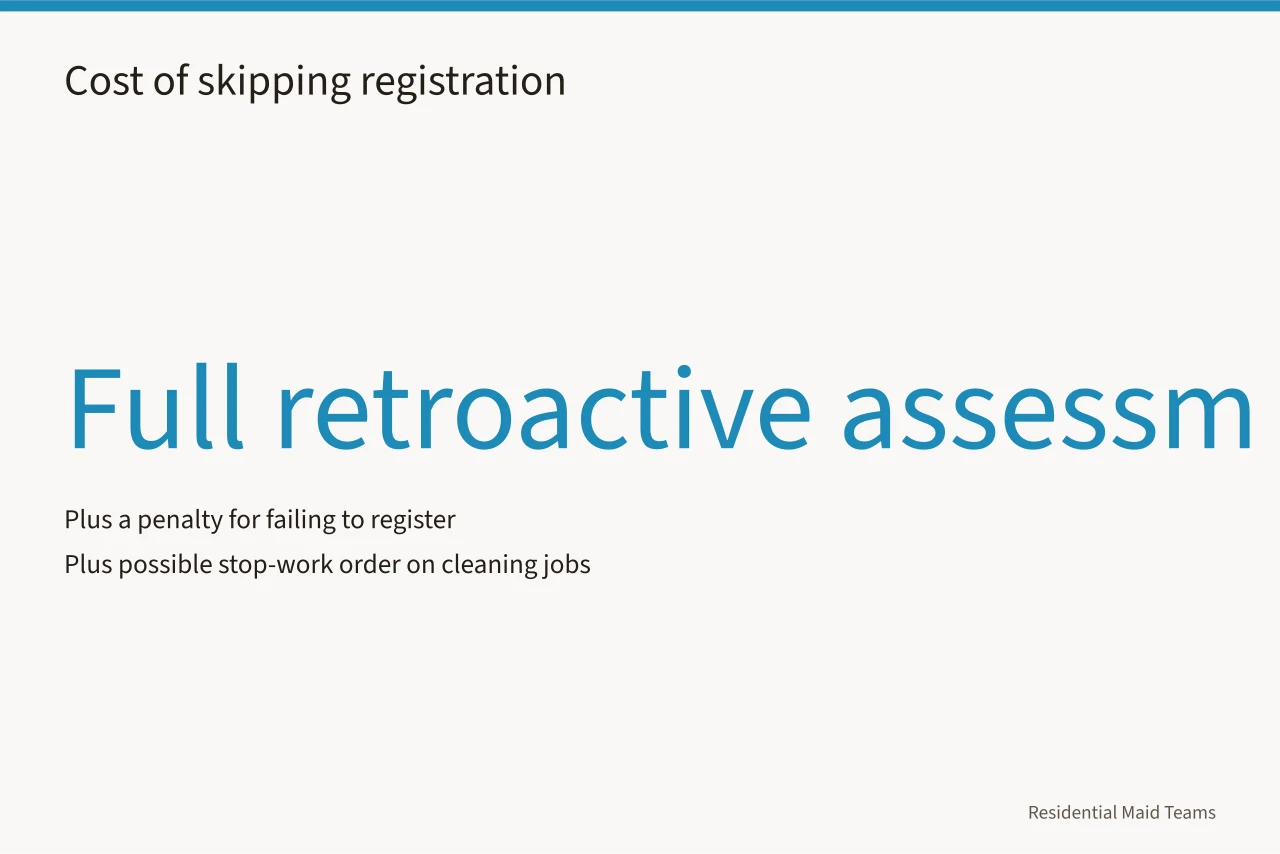
The practical consequence: an injured cleaner can still file a claim, and the unregistered employer can be billed for it. By law, most businesses need coverage, and WorkSafeBC warns that failing to register when required puts the business at considerable financial risk.