
Guides
How a commercial cleaning business runs the same way every day: SOPs
Commercial cleaning SOP checklist for daily operations in the order of the night: pre-shift cart check, arrival, area work, restrooms, close-out, and the shift log.
What to take away
- A standard operating procedure for a cleaning crew is a set of checklists in the order the night happens: pre-shift, arrival, area work, restrooms, close-out, and the log.
- The restroom list is separate because it is the one the customer judges you on and the one that needs its own tools and cloths.
- Every checklist item is something a supervisor can see was done. "Clean thoroughly" is not an item; "liners replaced at all stations" is.
- The close-out list is where keys, alarms, and lights go wrong. It is short, and it is done every night without exception.
- The log is the record. A night without a log entry is a night you cannot defend.
How to use these lists
Copy them, then edit each line to match your buildings' scopes and your safety program. The order is the order of the night; the operations and workflow guide explains why the inside-the-building sequence runs high to low and dry before wet. Print one set per site, or load them into whatever system your crews carry.
Pre-shift, at the vehicle
- Route for tonight read, with access windows and any customer notes.
- Keys, badges, and alarm codes for every site on the route in hand.
- Cart checked: vacuum runs, bag or filter clear, mop system complete, cloths sorted by color.
- Chemical caddy checkedbottles labeled as the safety program requires, none empty, data sheets where the program says they are.
- Protective equipment for tonight's products on the cart.
- Liners in every size tonight's sites use.
- Wet-floor signs counted.
- Spare vacuum and batteries in the vehicle.
- Coverage contact's number confirmed.
Arrival at each site
- Arrived inside the access window; time noted.
- Alarm disarmed per the site card; any fault reported to the customer contact immediately.
- Sign-in log completed if the site keeps one.
- Walk of the scope areas for anything unusualspills, damage, an area in use, a note from the customer.
- Anything unusual photographed and noted before work starts.
Area work, per task card
- Trash emptied and liners replaced at every station on the card, recycling kept separate where the site does.
- Surfaces dusted and wiped high to low as the card lists.
- Glass at entries and partitions spot-cleaned or cleaned as the card's frequency says.
- Kitchen or break area counters, sink, and appliance exteriors as the card lists.
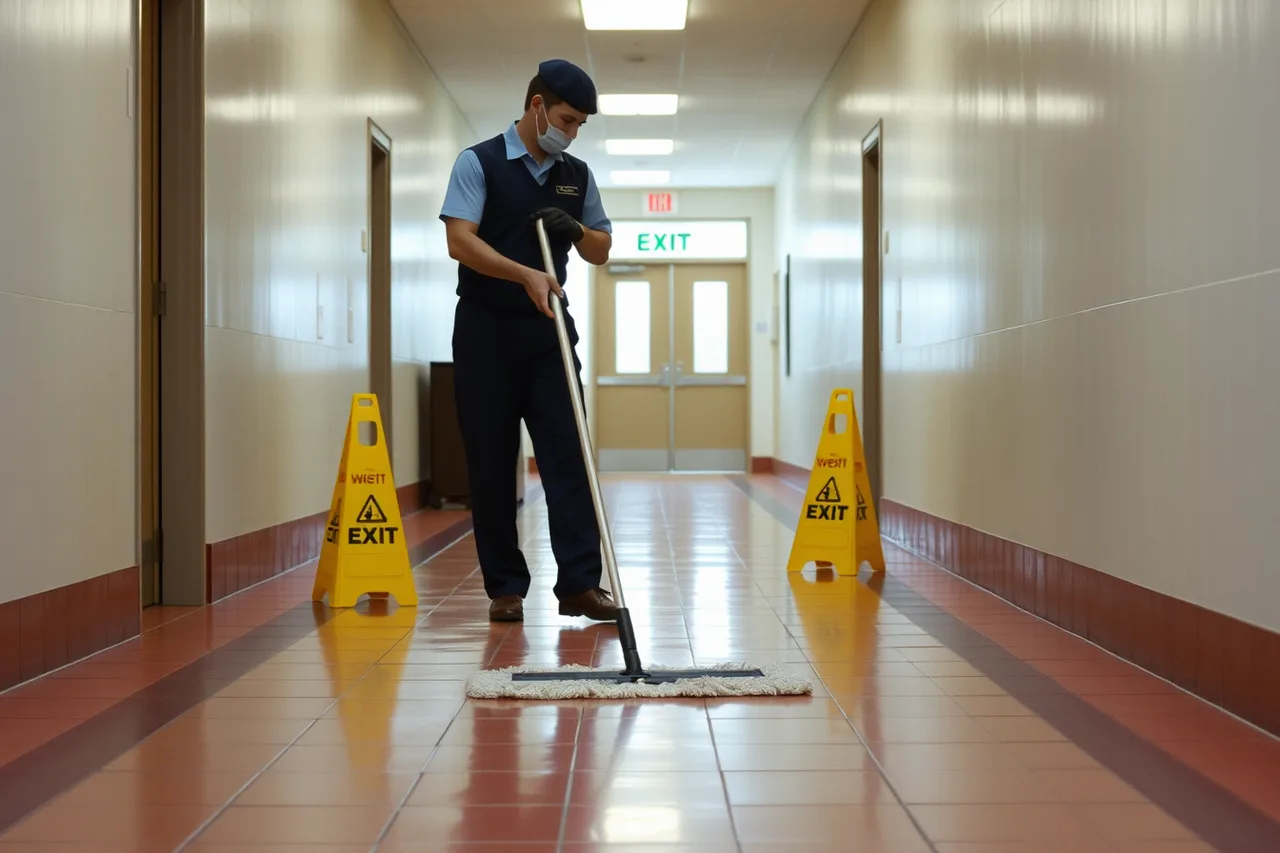
- Floors lastdust mop or vacuum, then damp mop where the card says, working toward the exit.
- Wet-floor signs placed before mopping and collected after the floor is dry.
- Weekly and monthly items on tonight's card done and ticked.
Restrooms, separate tools and cloths
- Restroom cloths and mop used here and nowhere else.
- Trash and sanitary bins emptied, liners replaced.
- Dispensers checked and refilled as the consumables policy says; shortages noted for the customer.
- Fixtures cleaned and disinfected with the product on the card, following its label's contact time.
- Mirrors, partitions, and touch points wiped.
- Floor mopped last, signs placed, door propped only while the floor dries if the site allows.
- Anything broken or leaking reported.
Close-out at each site
- Cart and tools collected; nothing left behind.
- Lights as the site card says.
- Doors and windows checked closed and locked.
- Alarm set per the site card; confirmation noted.
- Sign-out completed.
- Time noted.
The shift log
| Field | What goes in it |
|---|---|
| Site and date | Which building, which night |
| Arrival and departure times | From the arrival and close-out lists |
| Worker names | Everyone on site tonight |
| Card items not completed | Each one, with the reason |
| Reported to customer | What was reported and to whom |
| Supplies short | What ran out and where |
| Equipment faults | What failed and whether the spare was used |
| Incidents | Spills, injuries, alarm faults, anything unusual, with time |
The log is what the IRS page on what records a business should keep would call a supporting document for payroll, and it is also what a supervisor inspects against and what the customer sees when a dispute arises. Time entries by site are the timesheet the scheduling method reads to see whether a route is too long.
The safety lines
Several items above refer to your safety program, and this page does not say what that program must contain, because it depends on your size and products. OSHA's cleaning industry page lists the hazard categories the agency associates with cleaning work and links to the standards.
OSHA's page on the Hazard Communication Standard is the source text for what covered employers owe workers about hazardous chemicals. Ask OSHA's resources or a safety consultant what the bottle labels, data sheet location, and pre-shift training should be for your operation.
Then edit the caddy and protective-equipment lines above to match. The items the cart must carry to make those lines possible are in the equipment and setup guide.
Training on the lists
A new worker learns the lists by working them beside a trained person for the first shifts, then alone with a supervisor inspecting against the same lists. The hiring and training guide covers that sequence.
Whether the lists are worth the paper depends on whether anyone inspects against them, which is the subject of the next article in this cluster. And a business plan for a cleaning company that claims a quality system should be able to attach these lists as evidence.
Common questions
How detailed should a task card be?
Detailed enough that a new worker can complete the area without asking, and a supervisor can tick each line. If a line cannot be seen done, split it or remove it.
Should crews carry paper or a device?
Whichever they will actually use at night in a locked building. Paper that is filled in beats software that is not.
What if a customer asks for something not on the card?
Note it in the log, do it if it is small and safe, and send it to the owner for a scope addendum. The card changes when the contract does.
How often should the SOP be revised?
When a building changes, a product changes, or an inspection keeps finding the same miss. Otherwise leave it alone; a stable list is a learnable one.